


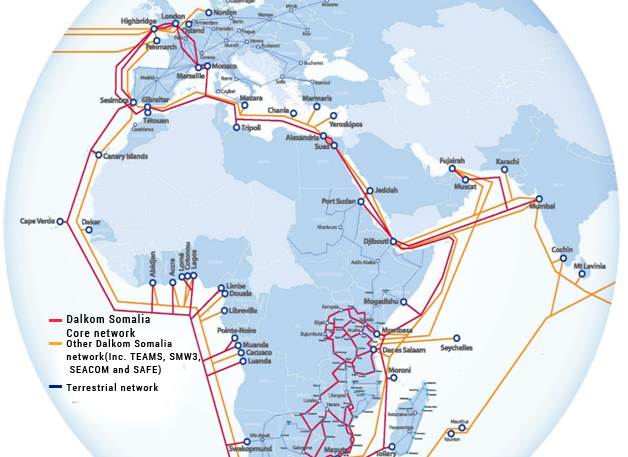
A decade ago the honest answer to why Somali internet was expensive and scarce was international capacity. Several submarine cables later, that is no longer the binding constraint. What limits coverage now is the last few kilometres — from a metro ring or a backbone route into an actual neighbourhood, campus, estate or town.
That final stretch is civil works. It is permits, trenching, ducting, splicing, and a maintenance obligation that lasts as long as the plant does. It is unglamorous, capital-intensive, and it is the reason so many coverage plans stop at the edge of the area they were meant to serve.
The three stages, and the one that gets underestimated
Design
Survey, route selection, permissions, and a design that accounts for how the area will grow rather than the cheapest line between two points. Cheap routes get dug up — by somebody else’s contractor, usually within the year. Route selection is where most of the eventual maintenance cost is decided.
Build
The visible part and the expensive one. Civil works dominate: the cable is a minor line item next to putting it in the ground. This is also where an experienced crew earns the difference in their rate, because rework in a trench costs several times what doing it once does.
Operate
The stage that is routinely left out of the business case. Fibre gets cut — by roadworks, by construction, by people digging for other reasons. Equipment ages. Estates expand and want more capacity than the design assumed. A network without a maintenance answer is a capital expense with an expiry date, and the expiry arrives sooner than the depreciation schedule.
Three models, and how to choose between them
The choice turns almost entirely on one question: do you want to be operating a network in five years?
Build and own
A turnkey build handed over to you — design, civils, plant, commissioning, and the documentation an operator actually needs afterwards. Right when the network is strategic to you, you intend to run it, and you want the asset on your balance sheet. It commits you to a maintenance capability, which you can build or buy but cannot skip.
Build and operate for you
The same build, with the maintenance, monitoring and fault response staying with the builder. You buy a service rather than plant. Right when you need the coverage and not the operations department, which describes most enterprises, most municipalities and a surprising number of ISPs.
Use somebody else’s
Where metro rings already reach, there is nothing to build. You take capacity on existing plant and start serving customers this quarter rather than next year. The obvious answer where it applies, and worth checking before commissioning any design — the footprint is usually larger than people assume.
The mistake that recurs
Building the access layer before securing the upstream. An access network with no backhaul behind it is a very expensive local area network, and retrofitting capacity to a build that did not plan for it is considerably more expensive than sizing it correctly at design stage.
The related version: designing for today’s subscriber count. Access builds are priced on the number of premises passed, and the incremental cost of a larger duct at trench time is trivial compared with the cost of trenching the same route again in three years.
What makes a build financeable
Single-tenant builds rarely pay for themselves. Routes that carry several operators, plus enterprise circuits, plus an access layer, do. That is an argument for shared infrastructure that the market has been slow to act on, largely because coordination is harder than building alone — but the economics are not ambiguous.
Where to start
Name the footprint and the premises you expect to serve. The first answer worth having is what already reaches that area — because the cheapest build is the one you do not do — and only then what building the remainder would take.

